
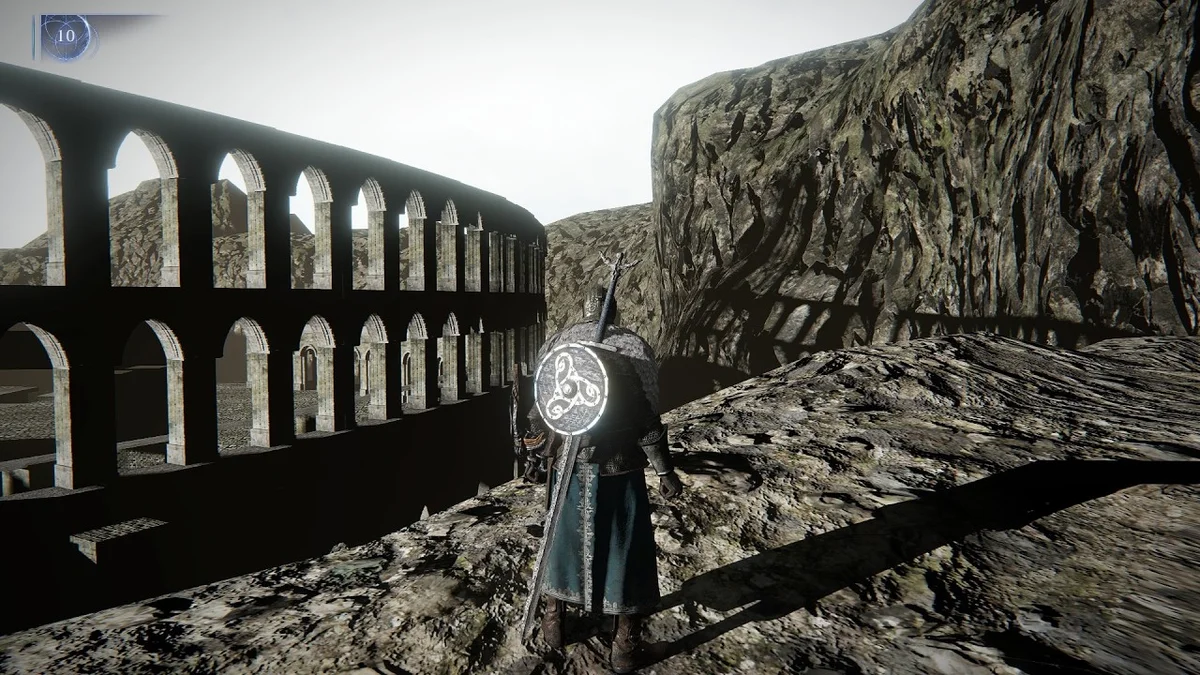
A Ghost Town in a Game's Archives
FromSoftware's worlds have a distinctive relationship with ruins.
Players explore fallen civilizations, reconstruct events from fragments and discover places whose original purpose has been partly forgotten.
There is something remarkably appropriate about the latest Dark Souls II discovery.
This time, the ruins do not exist solely within the fiction.
They belong to the real development history of the game.
Doneda has displayed the remains of an enormous environment that was created and subsequently discarded.
Its coliseum, mines, underground tower and crypt fragments resemble a world missing its inhabitants, events and perhaps much of its intended architecture.
The Mystery of an Arena Without a Battle
The prototype is remarkable for more than its size.
A coliseum carries an obvious implication in an action game. It suggests combat, spectacle or a trial designed for the player.
Yet this structure appears without the context necessary to establish its purpose.
It could have supported a major encounter, a ceremonial location or a connection between different areas.
None of those possibilities has been confirmed.
The missing explanation transforms the architecture into an object of speculation.
Players can observe an ambitious environment without knowing precisely what its designers hoped to achieve.
Every Finished Game Conceals Invisible Versions
Once a game launches, its final form tends to erase the versions that preceded it from public discussion.
Critics evaluate the levels available, the mechanics retained and the characters encountered.
Prototypes usually disappear unless developers choose to display them or community researchers uncover their remains.
Doneda's discovery reminds us that creation also involves abandonment.
A location may require substantial work before being discarded because of pacing, narrative changes or production constraints.
The exact reasons for removing this particular coliseum remain unknown.
It would be misleading to interpret the fragments as proof that the developers were forced to remove a superior version of the game.
The Temptation to Reconstruct a Perfect Dark Souls II
Cut content often creates nostalgia for a game that never existed.
An enormous arena can appear extraordinary when it is no longer subject to ordinary gameplay constraints.
However, impressive architecture reveals little about the quality of the combat it might have supported.
A gigantic arena could have produced an unforgettable boss encounter or simply resulted in exhausting traversal.
More interconnected areas might have improved Drangleic's coherence or complicated an already demanding adventure.
Cut content is not automatically content that should have survived.
The prototype demonstrates an abandoned possibility, not a definitively better game.
Doneda's reconstruction displays old resources using Elden Ring Nightreign, but it does not automatically restore their original gameplay systems.
Community Researchers Play a Crucial Role
This discovery belongs to a wider tradition of research carried out by players themselves.
Datamining can reveal unused objects, early character models and locations preserved in game files.
However, the work often requires more than finding forgotten data.
Researchers may need to identify formats, understand relationships between resources and develop methods to visualize them.
Doneda used Elden Ring Nightreign as an exploration environment for Dark Souls II's surviving assets.
That process turns technical experimentation into historical research.
It also has limits. Restoring geometry does not necessarily reconstruct the gameplay, narrative or creative intentions associated with it.
The Gutter, Eleum Loyce and Abandoned Paths
Doneda has previously explored an early version of The Gutter and experimented with bringing Eleum Loyce into a newer visualization environment.
These projects gradually reveal a Dark Souls II that changed significantly during development.
Each prototype offers another possibility: an alternative route, a different spatial arrangement or an abandoned interpretation of a familiar location.
They do not necessarily fit together into a single hidden definitive version.
Instead, they document successive stages of the creative process.
The Undead Crypt: Similarity Is Not Proof
The crypt fragment naturally invites comparisons with the Undead Crypt from the released game.
Both involve underground funerary environments.
However, visual or thematic similarity does not establish a direct development relationship.
Design documents, chronological asset records or developer testimony would be needed to determine precisely how the environments evolved.
Community research can propose valuable hypotheses without claiming to have resolved every part of the game's history.
Preserving Games Also Means Preserving Their Uncertainty
Videogame preservation often focuses on maintaining released software.
The priorities include compatibility, file integrity and documentation.
But prototypes preserve another kind of history.
They show how development teams experimented, revised, discarded and reorganized their ideas.
Because software changes continuously, these traces can disappear when tools, internal archives or older platforms become inaccessible.
Community projects can complement official preservation efforts by documenting material that would otherwise be forgotten.
They cannot replace the original creators' accounts, but they provide valuable evidence of the design process.
Dark Souls II Continues to Reveal Itself
The newly showcased coliseum does not change the official content of Dark Souls II.
It does not confirm a remake, DLC or restoration by FromSoftware.
However, it changes how the game's development history can be understood.
Behind the familiar regions of Drangleic are other possibilities, sometimes monumental, that never became part of the finished journey.
The released game remains the work players know, but the prototype demonstrates that it emerged from changing decisions rather than an immutable original plan.
Doneda's coliseum now resembles a monument to a creative direction that vanished before it reached the public.
It may contain no memorable battle, but it still tells an important story: the worlds players visit are only a fraction of the places developers once imagined.