
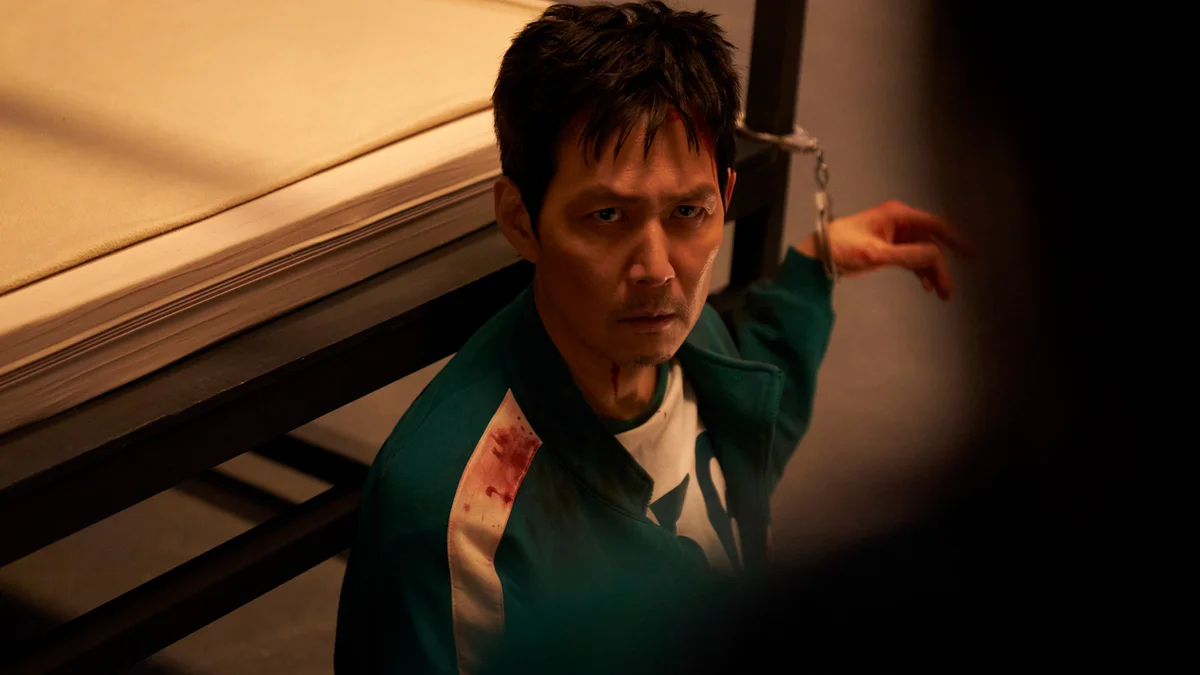
When playing becomes a question of survival
A giant doll, hundreds of green tracksuits and a brightly colored playground are enough to make Squid Game instantly recognizable.
Few television series have established such a powerful visual identity in their opening episodes.
Fewer still have used that identity to deliver social criticism understood far beyond their country of origin.
Created by Hwang Dong-hyuk, Squid Game begins with a devastatingly simple premise.
Four hundred and fifty-six people overwhelmed by debt enter a competition offering a prize of 45.6 billion won.
The challenges are inspired by childhood games. Losing means death.
The contrast between familiar activities and lethal consequences provides the show's central mechanism.
Rules that appear fair conceal a structure exploiting economic desperation.
The first season premiered on September 17, 2021, and became a global cultural phenomenon.
Two additional seasons followed in December 2024 and June 2025, completing the main story of Seong Gi-hun.
Squid Game can now be evaluated as a finished television work.
That perspective reveals an extraordinary achievement, but also the limitations of a story whose opening chapter established standards its sequels struggled to match.
An exceptionally effective satire of economic inequality
The first season's intelligence begins with the fact that the contestants are not simply prisoners held against their will.
The competition exploits their financial circumstances.
Outside the games, debts, creditors, inequality and limited opportunities have already made life almost unbearable for many participants.
The show introduces a cruel paradox.
The players theoretically have choices, but their economic circumstances severely restrict the freedom those choices represent.
Before the original release, Hwang Dong-hyuk described his concept in Netflix's official promotional material as an allegory of contemporary capitalist society.
The criticism works because it is not confined to dialogue.
The dormitory resembles a vast human factory.
The promised prize hangs above the contestants, constantly reminding them of the relationship between money and survival.
Collective votes transform human lives into financial calculations.
The show's political ideas are expressed through spaces and rules.
Most importantly, it makes understandable why individuals might accept conditions they know are dehumanizing.
The hope of escaping desperation becomes another instrument of domination.
This is why Squid Game is more interesting than a sequence of violent challenges.
It portrays a system in which the participants gradually absorb the logic being used to exploit them.
Seong Gi-hun is a deeply imperfect protagonist
Lee Jung-jae plays Seong Gi-hun, Player 456.
When the audience meets him, Gi-hun is indebted, irresponsible in some of his decisions and seemingly unable to regain control over his life.
The series could have portrayed him as an entirely innocent victim.
Instead, it chooses something more interesting.
Gi-hun possesses genuine generosity, but his admirable qualities coexist with significant flaws.
He can be sympathetic, frustrating, courageous and foolish.
That contradiction becomes essential as the competition develops.
He has neither the extraordinary physical abilities of an action hero nor the infallible strategic intelligence of a criminal mastermind.
His most distinctive quality is a continuing ability to recognize humanity in the people around him.
That does not make him morally flawless.
The system also forces him into difficult and sometimes questionable decisions.
Lee Jung-jae creates a convincing balance between desperation and humor, and later between guilt and moral determination.
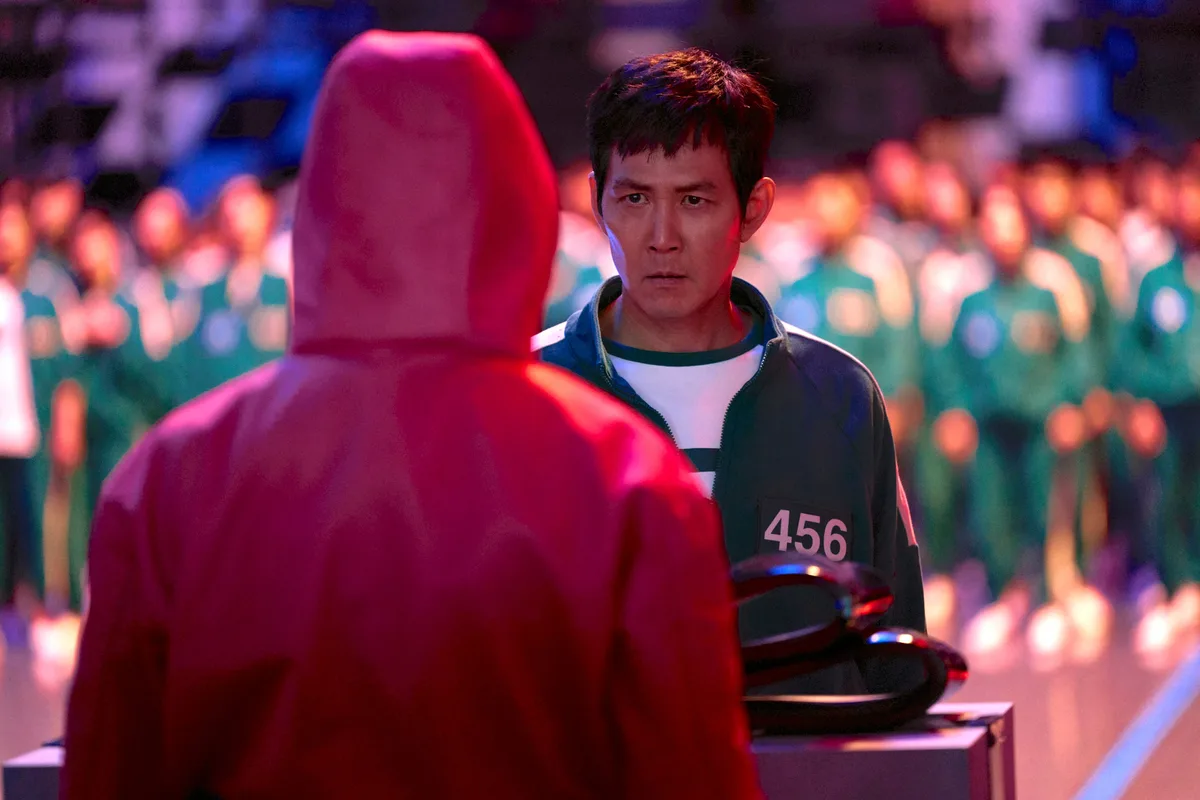
During the final two seasons, the character's narrative role changes.
He is no longer simply trying to survive. He wants to dismantle the organization responsible for the games.
This creates continuity, but it also introduces a dramatic problem.
Gi-hun sometimes becomes the representative of a moral argument rather than a character whose contradictions are allowed to evolve naturally.
His determination remains moving, while some of his decisions become less convincing than those of the first season.
Sang-woo, Sae-byeok and Ali give the first season its depth
The success of the opening season depends equally on its supporting characters.
Cho Sang-woo, played by Park Hae-soo, represents a different response to financial desperation.
His education and former social status have not protected him from financial collapse.
Inside the competition, his intelligence becomes a survival tool capable of justifying terrible choices.
Kang Sae-byeok, portrayed by Jung Ho-yeon, offers another perspective.
A North Korean defector, she pursues goals connected to her family while remaining deeply suspicious of those around her.
Ali Abdul, played by Anupam Tripathi, embodies a vulnerability connected to the experience of migrant labor.
These characters expand the show's social dimension beyond the story of one indebted man.
The participants do not share identical circumstances, resources or opportunities.
Yet the competition claims to subject everyone to the same rules.
That contradiction is extraordinarily powerful.
The episode centered on marbles is perhaps the strongest expression of this approach.
A simple children's game becomes devastating because viewers understand what the relationships between the contestants have come to mean.
The drama no longer depends only on the possibility of death.
It emerges from having to regard someone one cares about as an obstacle to survival.
Production design that became part of popular culture
Squid Game possesses an unusual visual achievement: its images remain recognizable even when separated from their narrative context.
The contestants' green tracksuits suggest a monitored collective.
The guards' pink uniforms turn the people enforcing the rules into anonymous figures.
Circles, triangles and squares reduce an entire hierarchy to simple geometric symbols.
The colorful staircases make the facility resemble an oversized children's environment, creating a violent contrast with the crimes committed inside it.
The aesthetic succeeds because it has narrative logic.
The colors do more than attract attention.
They establish distinctions between contestants, workers and those who control the competition.
The game spaces resemble illustrations from a children's book, yet their dimensions and surveillance create an intense sense of confinement.

Music and sound reinforce the contrast.
Apparently innocent melodies accompany situations of extreme violence.
Viewers quickly learn that nothing familiar guarantees safety.
The consistency between the premise, costumes, sets and sound design is one of the main reasons the series has remained culturally recognizable.
It also explains why the later seasons remain visually impressive even when their writing becomes less precise.
The first season achieves an almost perfect balance
The original competition benefits from exceptionally controlled progression.
Every new challenge introduces a different form of suspense.
Some tests depend on physical skill, while others require cooperation, strategy or betrayal.
The rules remain simple enough for audiences to understand the immediate risks.
Yet the most important developments often occur between games.
Alliances emerge, weaken and transform.
Decisions made during periods of rest can become as important as the abilities required in the competitions.
This prevents violence from becoming the show's only reward.
Audiences watch to understand how the characters will respond, not merely to discover another method of elimination.
The structure helps explain the exceptionally favorable reviews in 2021.
Rotten Tomatoes records a significantly stronger critical response to the first season than to the final installment.
That difference does not mean the sequels lack merit.
It demonstrates how difficult it was to recreate the balance of a story that seemed perfectly suited to its original length.
Season two turns survival into rebellion
When Squid Game returned on December 26, 2024, Gi-hun's objective had changed.
He now wanted to identify the people responsible and put an end to the competition.
The new direction made narrative sense.
A character familiar with the system could not simply rediscover the games as though the first season had never happened.
Hwang therefore introduces a conflict between returning to the competition and attempting to destroy it.
New contestants bring interesting perspectives, while collective voting becomes a more central mechanism.
The question of consent acquires additional importance.
Some players want to leave, while others hope to continue and increase the potential prize.
The conflict reveals how individuals facing the same danger can pursue incompatible interests.
This development deepens parts of the satire.
But it also creates repetition.
Votes, factional disputes and manipulation by the organizers follow patterns the first season already established.
Critical reception reflected that ambiguity.
Variety and other publications praised the second season's expansion of the story, while The Hollywood Reporter offered a much more skeptical assessment of its lack of genuinely new insights.
Both responses point toward a real issue.
The narrative becomes larger while losing some of the spontaneity of its first chapter.
The Front Man becomes the most interesting opponent
Lee Byung-hun gives the Front Man a presence extending beyond his costume and mask.
The character represents more than the authority supervising the games.
He embodies a belief directly opposed to Gi-hun's values.
For the Front Man, competition ultimately exposes humanity's selfish nature.
The confrontation between the two men provides the final seasons with an ideological direction.
Gi-hun wants to demonstrate that solidarity and compassion can survive under conditions specifically designed to destroy them.
The Front Man wants to prove that fear, greed and self-preservation will always prevail.

The contrast works partly because of Lee Byung-hun's restrained performance.
He rarely needs emotional outbursts to communicate authority.
His personal history makes his cynicism more disturbing than simple abstract villainy.
However, the opposition eventually becomes too explicit.
As the series approaches its ending, individual challenges increasingly seem designed to illustrate moral arguments the narrative has already stated.
The suspense survives, but some of the first season's subtlety disappears.
The new contestants preserve much of the emotional impact
Seasons two and three benefit from a new ensemble capable of making familiar challenges interesting.
Yim Si-wan, Kang Ha-neul, Jo Yu-ri, Park Sung-hoon and Kang Ae-shim are among the performers contributing to this phase.
Their characters represent different kinds of vulnerability, ambition and dependency.
Certain family relationships become especially powerful because they remind viewers that the stakes extend beyond financial reward.
The show can still create dilemmas with no entirely satisfying solution.
Nevertheless, several newcomers receive less time to develop than the most memorable characters from season one.
Some are primarily defined by a behavior or narrative function.
The risk is that contestants gradually become recognizable categories: the coward, the opportunist, the protector or the manipulator.
Whenever the writing moves beyond those first impressions, the series recovers much of its original strength.
When it does not, deaths can feel predictable because the characters appear to exist mainly for the next twist.
The investigation outside the island slows the narrative
Squid Game's world has extended beyond the contestants' prison-like environment since the first season.
The investigation conducted by Hwang Jun-ho, played by Wi Ha-joon, provides a way to explore the organization and its wider structure.
This expansion was necessary to prevent the sequels from becoming simply another sequence of competitions.
Unfortunately, the external investigation advances too slowly.
Journeys, suspicions and misleading clues occupy considerable screen time without producing equivalent narrative discoveries.
Season three intensifies the problem by continuing to divide attention between contestants, organization members and the search for the island.
The Guardian identified this pacing issue in its June 2025 review, arguing that secondary storylines diluted the central tension.
The weakness becomes particularly clear when a compelling game is interrupted by an external investigation with much less immediate dramatic momentum.
Expanding the universe should provide greater understanding of the system.
Here, it sometimes mainly slows the story.
The VIPs remain the weakest part of the writing
The wealthy masked spectators represent one of Squid Game's most immediately understandable ideas.
They watch the suffering of contestants as private entertainment and symbolize an elite powerful enough to transform other people's lives into a spectacle.
The concept works perfectly on a symbolic level.
Its execution is considerably less convincing.
The characters are caricatures, their dialogue frequently sounds unnatural, and their behavior often consists of commenting on ideas the audience already understands.
The series does not attempt to give these figures much complexity.
They exist to express the indifference of the powerful.
Such simplicity might have remained effective if used sparingly.
Instead, their repeated appearances in the later seasons weaken the surrounding scenes.
The Guardian and several of the reviews collected by Rotten Tomatoes repeatedly identify this problem.
The issue is not that the VIPs are morally repellent.
It is that they are dramatically less interesting than the people whose deaths they watch.
Season three concludes the story in extreme darkness
The final season premiered on Netflix on June 27, 2025, with six episodes.
It begins immediately after the tragic events of the previous season rather than offering the protagonist a comfortable new beginning.
Gi-hun has been devastated by the failure of his attempted rebellion.
The Front Man continues his moral experiment, while the surviving participants face new situations in which their lives depend on the decisions of others.
The violence becomes particularly relentless.
Hwang remains committed to denying the characters an easily reassuring conclusion.
That determination deserves recognition.
Squid Game does not suddenly transform its cruel universe into a story where good intentions guarantee survival.
But the increasing brutality raises a question.
At what point does accumulating suffering stop deepening a social argument?
Some final situations produce considerable emotion.
Others seem designed mainly to exceed the shock of the previous episode.
This helps explain the more divided response to the conclusion.
Rotten Tomatoes records a majority of favorable critical reviews, but a noticeably more reserved audience response.
That disagreement does not necessarily mean viewers uniformly wanted a happy ending.
It also reflects debates about the logic of the final developments and the changing balance between spectacle and satire.
Two seasons that might have worked better as one
The second and third installments form a large, almost continuous narrative movement.
Releasing them six months apart allowed Netflix to create two major events around that story.
Dramatically, the result is less successful.
Season two spends considerable time establishing the new conflict before ending on a major turning point.
Season three must recover that momentum while bringing several storylines toward their conclusions.
The combined experience suffers from a strange mixture of slowness and urgency.
Lengthy preparations contrast with some very rapid resolutions.
Several reviews of the finale identified this structural problem.
Rebecca Nicholson at The Guardian suggested that the two chapters could have formed one tighter season.
The observation is persuasive.
The narrative contains enough ideas to justify continuing beyond the original season, but not always enough distinct developments to avoid repetition across two additional seasons.
This does not erase the effectiveness of individual sequences.
It explains why the complete experience feels less precisely structured than the first installment.
A satire at risk of becoming the spectacle it criticizes
Squid Game contains a fascinating contradiction.
The series criticizes a system in which privileged individuals consume the suffering of others as entertainment.
Yet part of its audience's enjoyment comes from discovering new games, reversals and eliminations.
Hwang Dong-hyuk seems conscious of this ambiguity.
The series never completely allows viewers to forget that the competitions exist to satisfy the gaze of more powerful people.
But as the franchise expands, it becomes increasingly recognizable through its costumes, settings and competition mechanisms.
Netflix has developed immersive experiences, licensed products and the reality competition Squid Game: The Challenge.
Those extensions are not identical to the fictional drama, but they reveal a remarkable commercial tension.
A work condemning the transformation of human lives into entertainment becomes an international brand built around its games.
This paradox does not automatically make the series hypocritical.
Critical works necessarily circulate within the industries they examine.
Nevertheless, the contradiction deserves consideration when evaluating how later seasons increase the scale and intensity of the challenges.
The social criticism remains present, but it is sometimes overshadowed by the need to create ever more extreme spectacle.
An imperfect ending faithful to its central argument
Squid Game's conclusion inspired considerable discussion.
Without revealing its specific events, it is possible to identify the moral question driving the final episodes.
The show asks whether an individual's humanity can survive within an organization designed to transform every relationship into competition.
Gi-hun has embodied that question since the beginning.
The Front Man repeatedly attempts to demonstrate that compassion is merely a temporary weakness destined to disappear when confronted with fear and self-preservation.
The conclusion remains consistent with that central opposition, even when particular developments feel exaggerated.
The final images have been interpreted in different ways, partly because they suggest a potentially wider fictional universe.
However, the end of the main series should be distinguished from possible spinoffs.
Netflix and Hwang Dong-hyuk have confirmed that season three is the conclusion of the original Squid Game story.
A fourth season directly continuing this series has not been announced.
This allows the finale to be judged as the conclusion of an existing narrative rather than merely an advertisement for another installment.
A worldwide phenomenon that expanded Korean television's reach
The international impact of Squid Game remains an extraordinary achievement.
It demonstrated that a South Korean production performed primarily in Korean could become the center of worldwide cultural conversation.
That success cannot be explained solely by Netflix's geographical availability.
The immediately understandable premise, emotionally accessible characters and striking visual identity allowed audiences across different cultures to engage with the story.
The phenomenon also contributed to the international visibility of South Korean performers, creators and television production.
Netflix has repeatedly identified Squid Game among its most significant audience successes.
According to the platform, season three generated more than 60 million views during its first three days, establishing a major launch record under its reporting methodology.
Netflix's view metric is calculated from hours watched divided by program duration.
It should not be confused with a verified count of unique viewers.
Commercial success does not mean all three seasons received identical critical responses.
It nevertheless confirms the power of a fictional world that crossed linguistic boundaries without abandoning its cultural identity.
Verdict: 8/10, a television landmark that should have been tighter
Squid Game remains one of the most important series in Netflix's recent history.
Its first season combines nearly perfect narrative efficiency with memorable aesthetics and a compelling understanding of economic competition.
Lee Jung-jae creates a vulnerable, deeply human protagonist.
The supporting characters give emotional substance to social criticism that could otherwise have remained a provocative concept.
The final two seasons extend those ambitions with genuine achievements, particularly the development of the Front Man and several difficult moral dilemmas.
But they also accumulate repetition.
The external investigations lose momentum, the VIPs remain poorly written, and violence sometimes occupies more space than the ideas it was intended to express.
The conclusion is courageous in rejecting easy comfort without recovering the dramatic precision of the opening chapter.
The score of 8/10 reflects that balance.
Squid Game is not perfectly consistent across three seasons.
It is an exceptionally powerful creation whose continuations never fully rediscovered the freshness of the original.
Its legacy remains undeniable.
Hwang Dong-hyuk transformed a children's playground into a terrifying image of the contemporary world.
Even when its rules begin repeating themselves, the game's original meaning is difficult to forget.