
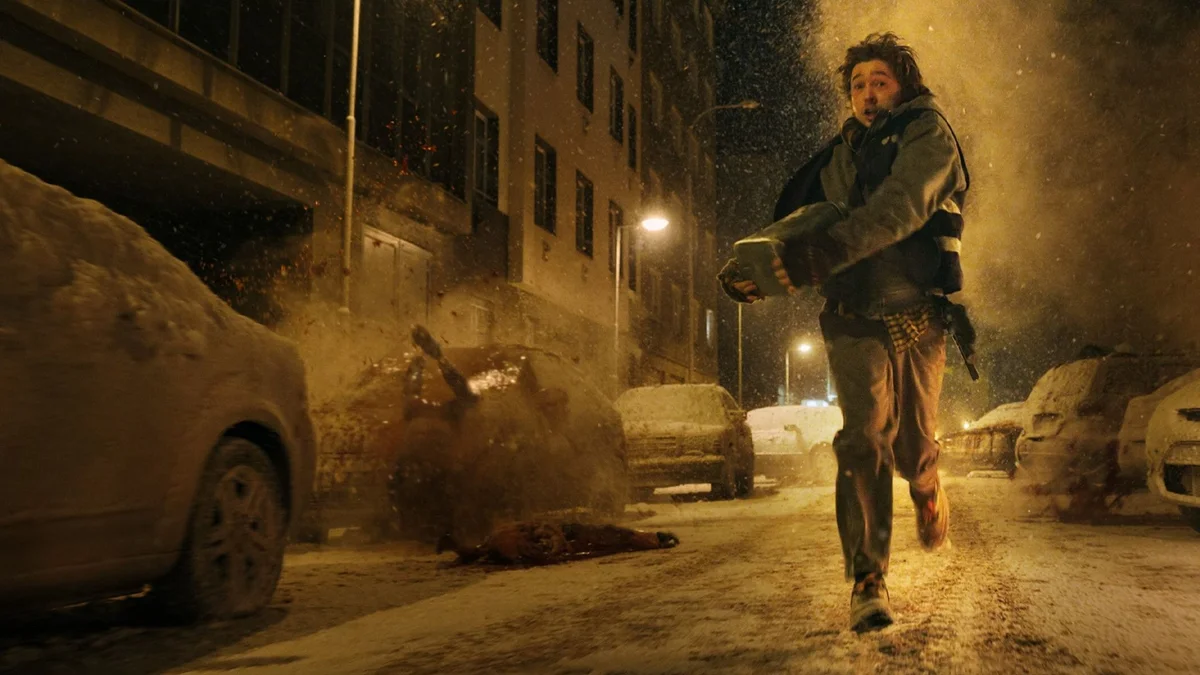
A delivery job becomes a survival nightmare
Bryan is not the kind of protagonist audiences usually associate with Resident Evil. He is neither a police officer trained to confront biological threats nor a professional survivor equipped for an extraordinary emergency.
He is a medical courier whose ordinary assignment becomes a disastrous night of escalating horror.
That premise allows director Zach Cregger to approach the franchise from an unfamiliar perspective. Bryan does not possess the confidence of Leon Kennedy or the combat experience of Chris Redfield. He is an ordinary person trying to understand how a routine task has turned into an almost impossible struggle to stay alive.
Austin Abrams plays him with a combination of bewilderment, nervous humor and genuine vulnerability. Even when Bryan makes obviously unwise decisions, the performance helps make those mistakes understandable.
The film's compact 94-minute runtime contributes to its momentum. Rather than expanding into an elaborate mythology, the narrative concentrates on the consequences of one increasingly disastrous night.
That decision gives the reboot a welcome sense of urgency. Its central question is not how an established hero will defeat another biological threat, but whether this particular man can survive the next encounter.
The film understands how survival horror works
Cregger's most important achievement is recognizing that Resident Evil's identity extends beyond familiar characters and recognizable creatures.
The games are frightening because they force players to navigate hostile spaces while managing uncertainty and limited resources. Danger is often found in the ordinary act of entering an unfamiliar room or continuing along a corridor whose destination is unknown.
The film translates those experiences into cinematic storytelling.
Bryan moves from one difficult objective to another. Solving an immediate problem rarely produces lasting safety. Instead, it frequently reveals a new obstacle, forcing him to improvise with whatever resources remain available.
Brian Tallerico's review for RogerEbert.com specifically emphasizes the film's game-like structure and the way its resource limitations resemble survival-horror mechanics.
The Guardian similarly praises the film's relentless momentum, noting how the narrative maintains tension through an escalating sequence of difficult situations.
This approach works because the film does not require audiences to understand the franchise's complicated continuity. Familiarity with Resident Evil adds context, but the fundamental experience remains accessible.
The viewer understands Bryan's vulnerability immediately. Every new environment becomes a potential threat because the character has little knowledge of what he may encounter.
Austin Abrams makes a terrible situation surprisingly funny
The film would be far less successful without Austin Abrams.
Bryan's decisions often appear irrational. He sometimes trusts the wrong people, attempts to help when retreat might be wiser and manages to make already dangerous circumstances even worse.
Those choices could easily have turned him into an irritating protagonist. Abrams instead presents them as the reactions of a frightened, fundamentally decent individual.
His comic timing is particularly important. Bryan does not behave like an action hero delivering carefully prepared jokes. His humor emerges from panic, discomfort and the absurdity of being trapped in situations no ordinary person could reasonably handle.
The Guardian highlights the actor's appealing everyman quality, while the Los Angeles Times recognizes how effectively Cregger uses that vulnerability to generate both sympathy and amusement.
There is a recognizable tradition behind this performance. Horror protagonists are often most engaging when their confidence is disproportionate to their abilities, or when they discover courage through a succession of humiliating failures.
Bryan belongs to that tradition, but Abrams gives him enough personality to remain more than a vehicle for monster encounters.
His reactions also provide a useful contrast to the extraordinary violence around him. The more grotesque the environment becomes, the more important it is that somebody responds like a believable human being.
Zach Cregger turns gore into controlled chaos
Cregger previously demonstrated in Barbarian and Weapons that he enjoys undermining audience expectations.
He can build an unsettling atmosphere, push a scene toward an apparently inevitable conclusion and then introduce an unexpected shift in tone.
Resident Evil applies that sensibility to a franchise traditionally associated with monsters, biological contamination and increasingly extravagant action.
The creatures are frequently grotesque, and the violence is substantial. The film's American R rating reflects its graphic gore and strong bloody content.
Yet the director does not rely exclusively on physical horror. Suspense also comes from uncertainty, spatial restrictions and the possibility that Bryan will respond badly to an unfamiliar threat.
The combination produces scenes that are frightening and absurd in equal measure.
James Berardinelli's ReelViews assessment particularly appreciates the film's use of intentional comedy. The Los Angeles Times likewise praises Cregger's ability to bring his horror influences into a playful, highly personal style.
That balance will not satisfy every viewer. Some of the broader comic moments risk reducing the danger immediately after the film has worked hard to establish it.
Nevertheless, the humor generally gives the experience a distinctive personality rather than undermining its horror.
The environments keep their threats unpredictable
Resident Evil is at its best when ordinary places become deeply unsafe.
Snow-covered streets, dark tunnels and institutional interiors are familiar settings transformed by the possibility of sudden violence.
The locations themselves establish unease before anything monstrous appears.
Cregger uses these environments to maintain uncertainty. A narrow passage can restrict Bryan's ability to escape. An apparently empty room may conceal a new danger. A promising route forward can become another obstacle.
The direction repeatedly encourages audiences to consider what they would do in the character's position, while denying them the information needed to make an obviously correct decision.
That relationship between uncertainty and vulnerability is central to the film's resemblance to the games.
It is also why the absence of traditional franchise protagonists matters less than expected. A recognizable hero might make a dangerous encounter exciting. An ordinary courier makes it frightening.

The supporting cast keeps the nightmare moving
Zach Cherry, Kali Reis and Paul Walter Hauser join Abrams in supporting roles.
Their appearances add new personalities and tonal variations to Bryan's increasingly chaotic journey.
Hauser is particularly suited to the film's combination of exaggerated behavior and grotesque comedy. The production makes use of his ability to appear both ridiculous and unsettling.
However, the film's concentrated structure also limits the development of several supporting characters.
They often function primarily as participants in individual situations, providing information, creating obstacles or introducing another unpredictable element into the unfolding catastrophe.
The approach supports the film's momentum, but it leaves relatively little room for relationships to develop beyond their immediate dramatic purpose.
This weakness becomes more noticeable when the story approaches its conclusion. Bryan receives substantial attention, while other characters remain comparatively underexplored.
An excellent ride with an incomplete ending
The film's greatest weakness emerges during its final stretch.
For most of its runtime, the story moves efficiently from one escalating crisis to another. The rhythm is exceptionally effective, and Cregger repeatedly finds new ways to complicate what initially appears to be a manageable situation.
But a relentless narrative eventually needs to deliver more than another obstacle.
The Los Angeles Times describes the ending as less controlled than the material preceding it. Other reviews collected by Rotten Tomatoes also identify an abrupt or unsatisfying resolution as the film's principal problem.
The Guardian makes a particularly persuasive observation: Bryan's journey receives so much attention that the conclusion should offer a meaningful sense of personal transformation.
Instead, the film seems to reach its final destination before fully resolving the emotional possibilities established earlier.
The weakness is not simply a matter of spectacle. The ending contains enough activity to maintain excitement. What it lacks is the character development that might have made the experience resonate beyond its immediate thrills.
This distinction is important because Cregger's earlier films demonstrated considerable interest in the human consequences of extraordinary horror.
Resident Evil occasionally seems more interested in finishing its survival-horror scenario than completing the personal story running through it.
Faithful to the experience, not the continuity
The decision to tell an original story is ultimately one of the film's greatest strengths.
There are no central roles for Leon Kennedy, Jill Valentine, Claire Redfield or Chris Redfield. Cregger does not reconstruct a specific game narrative.
Instead, he builds a new story around the mechanics and emotional sensations associated with Capcom's survival-horror franchise.
That distinction has helped the film reach an unusually positive reception.
As of October 21, 2026, Rotten Tomatoes lists a 96% positive critical response from 299 reviews, alongside a 90% verified audience score.
These percentages describe the proportion of favorable responses rather than average numerical ratings. They nevertheless reflect a remarkably strong reception for a franchise whose earlier cinematic adaptations frequently struggled with critics.
Some longtime fans may still prefer a more direct adaptation of the games they know.
But this film demonstrates that a recognizable franchise identity can survive major narrative changes when its underlying dramatic appeal remains intact.
A reboot with personality and purpose
Resident Evil is not without flaws. Its supporting characters could be stronger, its humor occasionally becomes excessive, and the final act is less satisfying than the excellent sequences leading into it.
Yet the central achievement remains impressive.
Cregger has made an adaptation that feels closer to the experience of playing a frightening survival-horror game than many films that borrow more directly from familiar video game storylines.
Abrams gives the nightmare a protagonist worth following. The creatures are memorable, the pacing is relentless and the film repeatedly finds ways to make ordinary environments threatening.
Most importantly, Resident Evil understands that horror depends on vulnerability.
The audience does not need to see a famous character facing a famous monster to experience that feeling. Sometimes it is enough to watch an ordinary person approach a dark doorway with no idea what waits beyond it.
Despite an imperfect ending, Cregger's film represents a convincing and genuinely entertaining reinvention of the franchise.