

Animals leads Netflix with 23.8 million views
Netflix's figures published on October 13 place Animals at the top of its global English-language film chart for the week of October 5 through October 11, 2026.
The thriller recorded 23.8 million views and 42.8 million hours watched during the reporting period.
That result is particularly notable because the film did not arrive on Netflix until Friday, October 9. Its total therefore reflects only three days of availability within the measured week.
Animals finished ahead of Tyler Perry's Doing Life, which ranked second with 18.2 million views.
The broader chart also included family-oriented releases and older movies already established in the catalog, demonstrating how different kinds of entertainment compete for attention on the platform.
There is an important methodological distinction. Netflix calculates views by dividing total hours watched by a title's running time. For Animals, the platform uses a duration of approximately one hour and forty-eight minutes.
Consequently, 23.8 million views does not establish that 23.8 million unique people watched the entire film.
A viewer may watch a title more than once, and individual viewing sessions do not necessarily represent completed screenings.
The ranking also does not establish an all-time Netflix record. It confirms that Animals led a specific weekly chart and generated substantial consumption immediately after release.
For a self-contained adult thriller without an established franchise behind it, that remains an impressive opening.
A political candidate faces a crisis he cannot campaign his way out of
Affleck plays Mark Kimball, an independent candidate for mayor of Los Angeles.
With the election only days away, his campaign faces mounting financial difficulties. Mark must continue presenting himself as a credible political leader while trying to hold together an increasingly fragile operation.
His public image has been carefully developed. He is a committed local figure, a dedicated husband and a loving father.
That appearance begins to collapse when his son Denny is kidnapped.
A ransom demand draws the family into a crisis threatening both their security and Mark's political ambitions.
His wife Abigail, played by Kerry Washington, must confront a series of decisions neither of them anticipated.
The basic premise is familiar from many crime thrillers: parents must find the money required to rescue their child.
Animals introduces an additional problem. The Kimballs are not ordinary private citizens who can attempt to resolve the crisis without public consequences.
Every decision may affect the election. Every personal revelation could provide ammunition to political opponents.
And every compromise made in desperation threatens to contradict the principles Mark has publicly promised to defend.
The kidnapping therefore becomes a source of moral pressure rather than simply a plot mechanism.
The question is not only whether the family can save Denny, but also what the parents are willing to sacrifice in the process.
Kerry Washington gives the marriage its own conflict
Abigail is essential to the film's central tension.
A successful therapist, she participates reluctantly in her husband's mayoral campaign, without necessarily sharing all his ambitions or priorities.
Their marriage is already under strain before the kidnapping begins.
Both characters are keeping secrets, while the approaching election has given them reasons to postpone difficult conversations.
In Netflix's official cast guide, Washington explains that the importance of the marriage was one of the reasons she agreed to the project.
She initially suspected that Affleck was emphasizing the relationship to persuade her to take the role. Reading the screenplay convinced her that the couple's dynamic was genuinely central to the story.
This makes Animals more complicated than a straightforward account of a united family confronting criminals.
The extraordinary circumstances force two people to confront problems they had previously found ways to avoid.
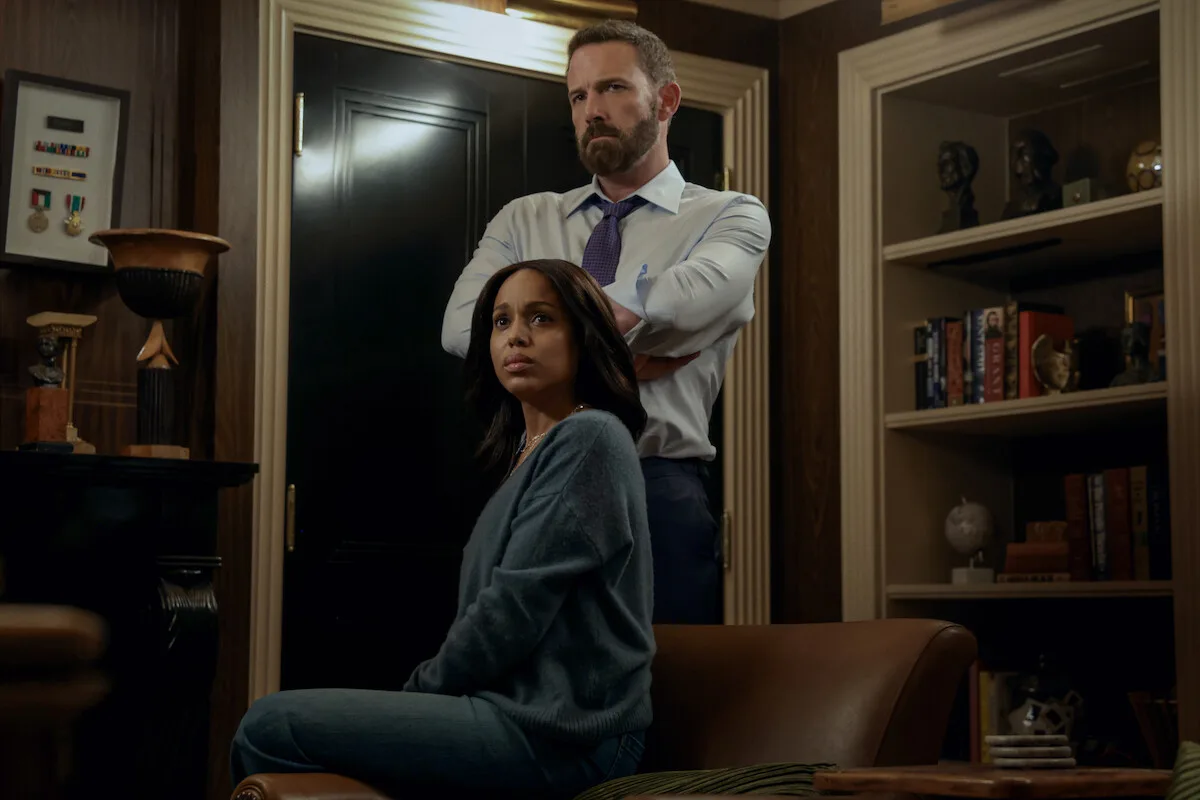
The pairing of Affleck and Washington is also a major promotional asset for Netflix.
Both performers have recognizable careers, but their characters are positioned within a story designed to challenge the audience's initial impressions.
Washington, particularly familiar to television audiences through Scandal, has previously played characters caught between American political power and private responsibility.
Animals does not reproduce that series' structure, but it explores related dramatic territory: the unstable boundary between public reputation, personal identity and the demands of political life.
Ben Affleck returns to directing with a moral crime story
Animals is another feature directed by Affleck, who also produced the film, contributed to the screenplay and plays its central character.
His filmmaking career has frequently focused on people facing difficult choices under pressure.
Gone Baby Gone, The Town and Argo helped establish a directing style associated with crime, institutional systems and conflicts between personal loyalty and broader responsibilities.
Animals continues that interest while introducing a different set of circumstances.
Where Argo followed a rescue operation amid an international diplomatic emergency, the new film brings the conflict into an American family whose political position makes it especially vulnerable.
In an interview published by Netflix Tudum on October 9, Affleck described his interest in the gap between people's stated moral principles and their actual decisions.
Do individuals follow a genuine ethical compass, or do they make choices based on self-interest and then construct explanations that make those choices seem morally acceptable?
That question gives the film its political dimension.
A candidate can publicly defend transparency and accountability while privately concealing information that might destroy his career.
The audience is placed in an uncomfortable position.
Viewers may understand a father's desperation without agreeing with everything he does in response.
Empathy and approval are not necessarily the same thing.
Gillian Anderson and Steven Yeun make trust more complicated
The supporting cast plays an important role in the shifting balance of trust.
Gillian Anderson portrays Dayle Burton, a fixer brought in to help the Kimballs find a way out of the kidnapping crisis.
Dayle takes control of the situation and demands complete honesty from the people involved.
That requirement is particularly difficult in a household where everyone has reasons to keep certain information private.
Steven Yeun plays a member of Mark's political team, connecting the personal emergency to the strategy and pressures of the mayoral campaign.
Adriana Paz and Luis Gerardo Méndez portray characters connected to the Kimball household and its everyday operations.
Their different positions introduce additional social dimensions into a story that initially appears centered on a wealthy political family.

Netflix also confirms appearances by Ray Fisher, Mark Kassen and Christopher Woodley, the latter playing Denny Kimball.
Affleck has explained that he deliberately considered the expectations audiences bring to recognizable performers.
He wanted those assumptions to become part of the storytelling, allowing perceptions of the characters to change as more information emerged.
The approach fits a thriller in which the audience's understanding of individual motives is constantly being tested.
Los Angeles is essential to the story
Animals was filmed in and around Los Angeles, the city where its fictional mayoral campaign takes place.
Netflix emphasizes the production's commitment to using the location and supporting the local filmmaking community.
The setting is more than a backdrop.
Mark Kimball is running for office in a city defined by sharp differences in income, opportunity, culture and political influence.
His public identity depends on convincing voters that he understands their lives and can represent their interests.
That relationship with the city becomes more revealing when the candidate is forced to prioritize his own family's needs.
Los Angeles provides a setting where privileged homes, campaign offices and less affluent communities can exist within the same political narrative.
The thriller remains focused on a family emergency, but the larger city constantly influences the choices available to the people involved.
The shooting location also has an industry dimension.
Netflix and the filmmakers have emphasized the importance of keeping production work in Los Angeles at a time when the geographical distribution of Hollywood filmmaking remains a significant concern.
Artists Equity brings Ben Affleck and Matt Damon together behind the scenes
Animals was produced in partnership with Artists Equity, the company founded by Ben Affleck, Matt Damon and Gerry Cardinale.
Affleck and Damon are among the producers, alongside Dani Bernfeld, Brad Weston and Collin Creighton.
The project was also developed with Makeready and Fifth Season.
Damon's involvement as a producer should not be confused with an acting appearance.
Earlier casting plans changed during development before Affleck ultimately took the lead role himself.
Such changes are common in filmmaking, where financing, scheduling and the availability of performers can reshape a project between its initial announcement and production.
For Netflix, Animals offers several recognizable commercial advantages.
It has an established director, a prominent ensemble, a clear thriller premise and a complete story that does not depend on an existing fictional franchise.
Viewers do not need to follow multiple seasons or understand a shared universe to enter the story.
The film delivers a self-contained narrative in approximately 108 minutes, a format that can be particularly accessible within a crowded streaming catalog.
A massive opening is not yet a long-term verdict
The October 13 ranking establishes a strong beginning, but it cannot determine how long Animals will remain among Netflix's most-watched movies.
Early interest may reflect the prominence of the title on the platform, the reputation of its stars or the impact of its promotional campaign.
The public viewing data does not isolate the contribution of those factors.
Nor does the number of views directly measure satisfaction.
A film can attract considerable initial curiosity, receive mixed reviews and still provide commercial value to a subscription service.
The early critical response illustrates that distinction.
Some commentary has highlighted the premise and performances, while other reviewers have criticized the complexity of the plot and its shifting tone.
In a review published on the day of release, Decider argued that the film's increasingly complicated narrative undermined some of its ambitions.
The No. 1 ranking should therefore not be presented as evidence of unanimous critical approval.
It is also impossible to convert 23.8 million views directly into a financial profit figure.
Netflix operates primarily through subscriptions and does not publish a precise amount of revenue generated by each individual film.
The platform may evaluate viewing, subscriber engagement and the long-term value of its catalog, but the available public statistics do not establish Animals' complete economic return.
Netflix gives Affleck's filmmaking a global platform
Animals is not Affleck's first experience with streaming distribution.
The actor and director has participated in productions for digital platforms while continuing to work on films released theatrically.
His new thriller uses a particularly revealing distribution model.
Netflix made Animals available on its service on October 9 while also scheduling a limited theatrical release in selected American cinemas.
That restricted cinema engagement should not be confused with a conventional nationwide theatrical rollout.
The main commercial event takes place through streaming, where a new film can reach a global audience almost immediately.
The model also changes how success is communicated.
Traditional studios emphasize ticket sales and box office revenue, whereas Netflix presents measures of consumption.
These indicators answer different questions.
A cinema admission corresponds to a purchased ticket. A Netflix view represents a calculated quantity of video consumption.
The strong performance of Animals does not prove that an equivalent theatrical release would have generated comparable revenue.
It demonstrates that the film has found a large initial audience within its actual distribution environment.
The politics of Animals begin where the speeches end
The title Animals suggests behavior that the characters may be reluctant to recognize in themselves.
It evokes what can emerge when social rules, public promises and carefully maintained appearances stop protecting people from their own contradictions.
Mark Kimball wants voters to see him as a responsible public servant.
Faced with a personal crisis, that identity becomes both an asset and an obstacle.
Abigail must decide which truths can be revealed without endangering her family.
Around them, political advisers and intermediaries possess interests that do not always align with those of the couple.
Secrets therefore become as important to the thriller as the kidnapping itself.
Affleck presents Animals as a story without a conventionally flawless hero. The audience's judgment of the characters is intended to evolve as their motives become clearer.
That approach allows the film to ask a more difficult question than whether the ransom can be paid.
When someone publicly commits to a principle, can they still respect it when following that principle requires genuine personal sacrifice?
The first three days have demonstrated that millions of Netflix viewers were interested in discovering Affleck's answer.
The coming weeks will show whether Animals maintains that momentum.
For now, Netflix has a clear early viewing success built around an unusually uncomfortable idea: the most dangerous revelation in a crisis may not concern the people responsible for it, but the people who believed they already knew exactly who they were.