
Karaoke was a social experience long before smartphones acquired front-facing cameras.
What has changed is the ease with which a performance can become a video that circulates beyond the room where it was recorded.
Apple Music's newly discovered Selfie Sing feature brings those two activities into one application.
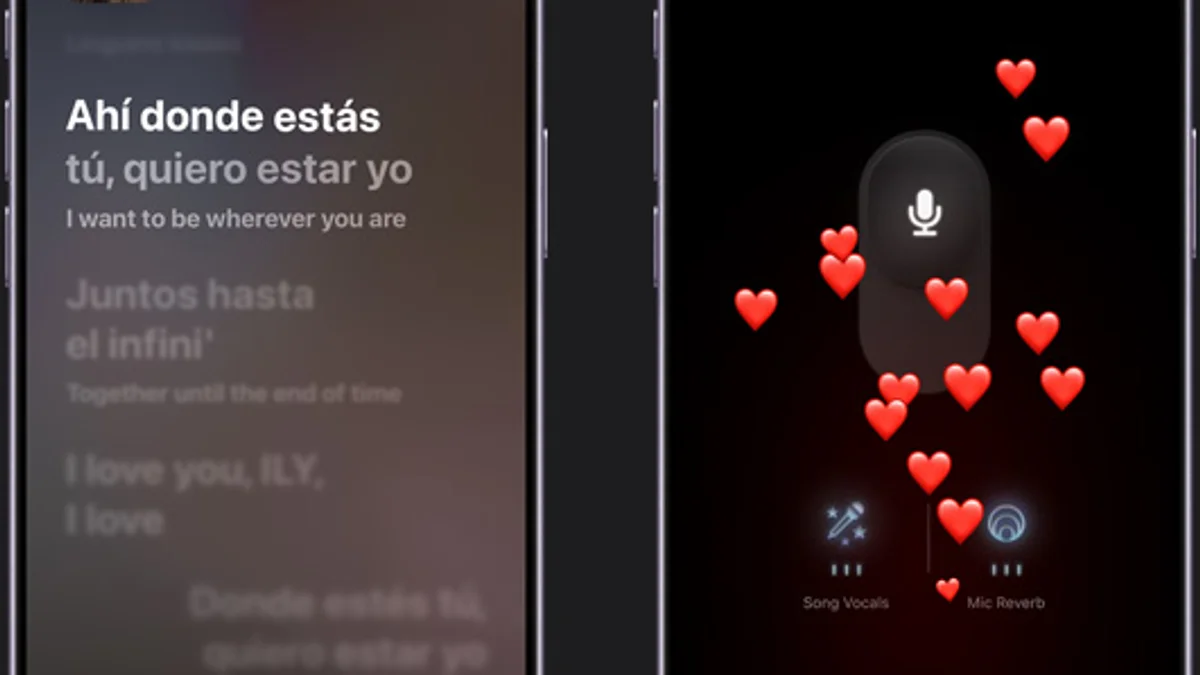
Users select an eligible song, open a camera view and perform while the lyrics move across the screen.
Once the recording is complete, the video can be adjusted, saved and shared.
The feature was spotted in the first iOS 27.3 developer beta released on November 3, 2026. Aaron Perris shared early demonstrations, and technology publications subsequently confirmed its operation.
Apple has not yet issued a standalone public announcement explaining the feature in full.
The functionality is real within the beta, but it should not be mistaken for a completed public launch.
From singing along to creating a performance
Apple Music already provides synchronized lyrics and adjustable original vocals through its Sing feature.
That functionality, introduced in December 2022, makes it easier for listeners to take over the vocal part of a familiar recording.
Selfie Sing adds a recording layer.
Users begin with a dedicated collection of supported songs. After selecting one, a camera control opens a view designed to capture their performance.
The song lyrics remain visible during recording, allowing the performer to follow the words without using another screen.
A red record button starts the capture.
The resulting video is vertical, matching a format widely used in social media applications.
This removes several steps that would otherwise require separate tools.
A user no longer needs to synchronize a camera recording with a music player and manually arrange lyrics during capture.
That convenience may be the feature's principal attraction.
However, early testing indicates a recording limit of approximately one minute.
Selfie Sing currently looks better suited to short performances than full-length karaoke videos.
Four audio effects, with a deliberately simple workflow
After recording, users can change the level of their captured voice.
Apple also offers four vocal effects named Megaphone, Echo, Concert Hall and Studio.
The tools provide quick changes to how the performance sounds.
They should not be confused with a professional audio workstation or a confirmed automatic pitch-correction system.
Apple has not published technical specifications establishing that Selfie Sing can correct every inaccurate note or independently produce a polished studio recording.
The existing controls are designed for immediate experimentation.
Users can then save the resulting clip to Photos or share it through supported iPhone workflows.
This makes Apple Music a starting point for video creation, while leaving distribution to other applications.
Apple is not launching a public Selfie Sing social feed as part of the beta.
Its approach is to create a performance inside the music service and allow the user to take that creation elsewhere.
A small catalog of unusually recognizable songs
The first Selfie Sing playlist contains a limited selection of tracks rather than the entire Apple Music library.
Hands-on testing has identified approximately 49 supported songs.
They include well-known recordings associated with artists such as Aretha Franklin, Cyndi Lauper, Madonna, Oasis, Duran Duran and Britney Spears.
These are songs with considerable cultural recognition and frequently memorable choruses.
That makes them useful material for a short performance.
The viewer does not need to hear an entire song to recognize a familiar musical moment.
It also creates a constraint.
A subscriber's favorite song may be available for ordinary playback or traditional Apple Music Sing but unavailable for Selfie Sing recording.
Apple has not published a complete schedule for expanding the compatible catalog.
There is no confirmed basis for assuming that all songs with synchronized lyrics will eventually support video recording.
Why a music service would want to create videos
Music streaming platforms have traditionally competed through catalog access, personalization, audio quality and exclusive programming.
Selfie Sing introduces another dimension: participation.
A listener becomes a performer, even if the result is only intended for a small group of friends.
That activity can extend the role of the app into social occasions and casual creativity.
For Apple, the feature also uses assets its music service already possesses: tracks, synchronized lyrics and karaoke controls.
Recording and voice effects make those elements more interactive without requiring an entirely separate product.
There is a commercial interpretation here.
A service that users open to create something may become more embedded in their routines than one used exclusively for passive listening.
But Apple has not reported engagement targets or financial projections for Selfie Sing.
The potential effects on subscriber loyalty and social distribution remain hypothetical.
An existing Apple experiment provides a useful comparison.
The company previously offered Clips, a simplified short-video creation app that was removed from the App Store in October 2025.
Selfie Sing is not a full replacement. Its capabilities are narrower and directly tied to the Apple Music catalog.
The integration suggests a different approach: embedding creative tools into an application people already use.
Sharing music videos raises licensing questions
A recording made inside a licensed music service is not necessarily unrestricted content.
Music rights, synchronization permissions and social platform policies can affect where a video may be published.
Apple has not publicly detailed the licensing arrangements specific to Selfie Sing exports.
The company also has not explained whether sharing limitations will differ by country or destination platform.
Consequently, the ability to save or share a clip should not be presented as confirmation that every social service will accept it without restrictions.
This may become increasingly relevant if the feature eventually supports a much larger selection of songs.
For now, the beta demonstrates the creation workflow without resolving every question about distribution.
A small experiment with a potentially larger audience
The initial feature requires an iPhone running the iOS 27.3 developer beta.
The dedicated playlist can already appear on older software, including iOS 27.2, but the recording control is absent there.
Apple has not confirmed the full list of compatible devices, territories or future supported platforms.
The public release of iOS 27.3 is expected in December 2026, although the final availability of individual beta features has not been established.
The opportunity is easy to understand. Selfie Sing lets someone turn a familiar chorus into a short personal performance without leaving the music app.
Whether that becomes a lasting behavior or simply another occasional novelty remains unknown.
The broader development is that Apple Music is experimenting with an experience where listening, performing and sharing form one connected activity.