
Sacrifice arrives on Netflix with an unusually eclectic cast
Friday, October 16, 2026, marks the Netflix release of Sacrifice in markets including the United States and France.
The streaming service introduced the film through an official September announcement and trailer, highlighting the confrontation between Chris Evans and Anya Taylor-Joy.
Romain Gavras directs the feature after his previous Netflix film Athena, released in 2022.
This time, the filmmaker combines the scale of action cinema with dark comedy, social satire and imagery influenced by ancient mythology.
The cast is one of the project's immediate attractions.
Evans and Taylor-Joy occupy the leading roles, supported by Vincent Cassel, Salma Hayek Pinault, John Malkovich, Ambika Mod and Sam Richardson.
Musicians Yung Lean and Charli xcx also appear in the production.
Netflix identifies Charli xcx's character as Mother Nature, although Gavras describes her appearance as a small cameo rather than a major role.
The entire combination is deliberately larger than life.
Gavras wants to move between violence, absurdity, satire and genuine questions about belief.
The challenge is to make those different registers work together rather than allowing the spectacle to overwhelm the story.
Chris Evans plays an action star desperate for relevance
Evans portrays Mike Tyler, a former action movie star whose career and personal confidence are deteriorating.
Once accustomed to occupying the center of attention, Mike is now searching for a way to restore his professional status.
An environmental charity gala on a Greek island offers him an opportunity to return to the spotlight.
The character has an obvious satirical dimension.
Mike has spent much of his career pretending to be a hero on screen, but his real life no longer provides the same sense of importance.
Sacrifice places him in circumstances where performing heroism is no longer enough.
The decisions he faces have consequences that cannot be resolved by simply reaching the final scene of a Hollywood production.
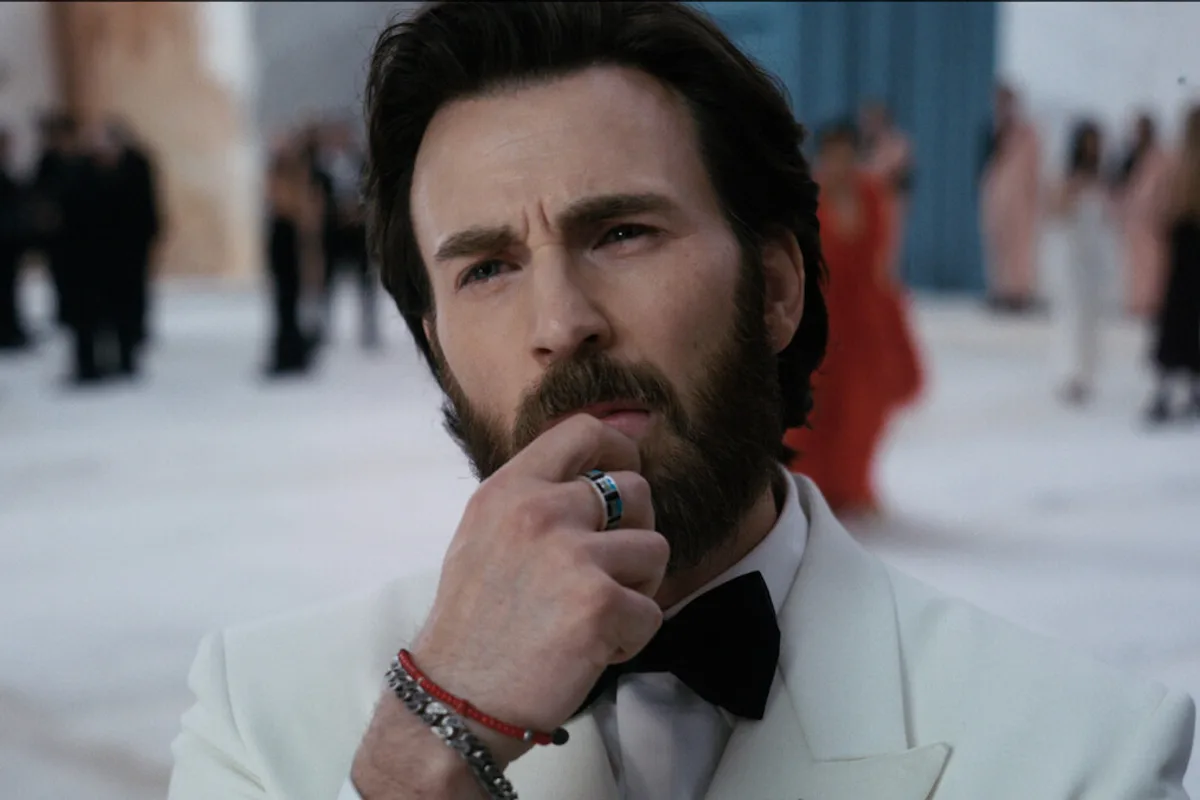
Casting Evans allows the film to take advantage of the audience's familiarity with his heroic screen image, particularly his years playing Captain America.
Gavras has explained that he was attracted to the actor's comic timing and his ability to understand the expectations audiences already bring to his performances.
Mike Tyler is not a straightforward parody of Steve Rogers.
Instead, he represents a kind of celebrity whose identity has become so dependent on public approval that genuine action may be difficult to distinguish from performance.
The contrast between appearance and conviction runs through the film.
Mike knows how to play someone capable of saving the world.
The question is whether he can do something meaningful when he no longer controls the script.
Anya Taylor-Joy interrupts the party with an apocalyptic prophecy
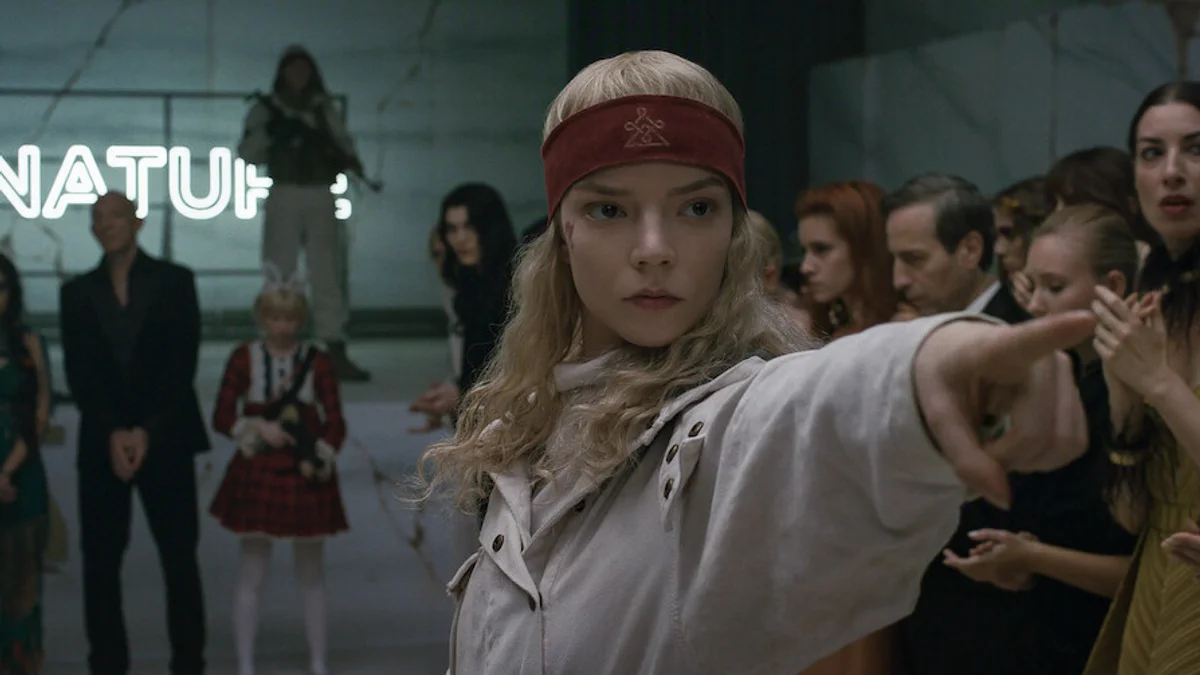
Taylor-Joy plays Joan, the leader of a radical group convinced that humanity is approaching a catastrophic event.
According to their beliefs, an extinction-level disaster will occur in three days unless three people are sacrificed to a nearby volcano.
Joan and her followers interrupt the gala and take several guests hostage.
The premise sounds absurd, but the character does not regard it as a joke.
Joan believes deeply in the mission and sees its violent requirements as necessary.
That certainty distinguishes her from a criminal motivated solely by money or personal revenge.
She is not demanding an ordinary ransom.
She believes the fate of humanity depends on a ritual that must be completed.

In Netflix's promotional interview, Taylor-Joy discusses the film's contrast between individual effort and collective action.
She also identifies a criticism of contemporary society's tendency to prioritize distractions over more consequential problems.
However, the character's conviction should not be confused with justification for her actions.
A sincere belief does not make hostage-taking or violence morally legitimate.
The film uses precisely that contradiction to develop its satire.
Some characters publicly embrace worthy causes while avoiding meaningful personal responsibility.
Others are willing to commit terrible acts because they believe those actions are essential.
Neither position automatically offers an acceptable answer.
An environmental gala where billionaires mainly want photographs
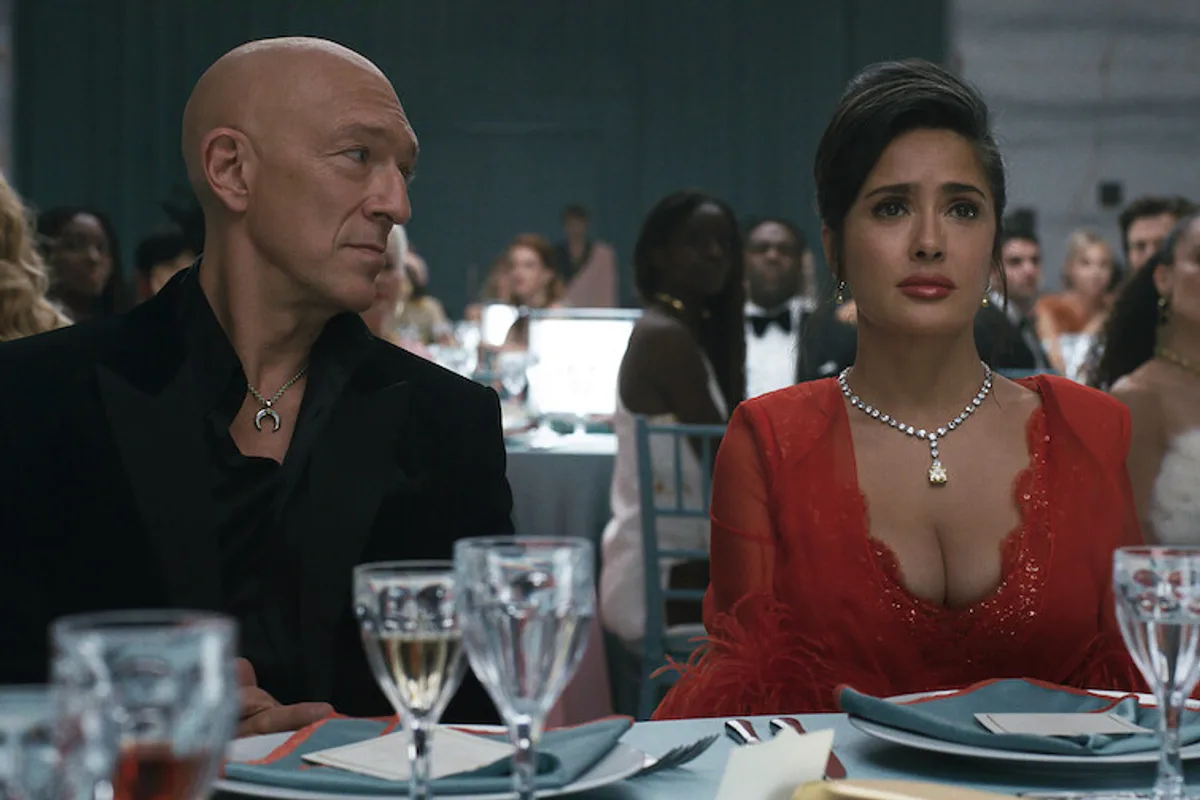
The event at the center of the story is hosted by billionaire Ben Bracken, played by Vincent Cassel, and his wife Gloria, portrayed by Salma Hayek Pinault.
The gala promises to celebrate environmental commitment among influential public figures.
Celebrities, major fortunes and photographers gather in a spectacular location where the appearance of action may be as important as action itself.
Gavras presents the event as an example of superficial commitment.
Guests want to associate themselves with an important cause without necessarily accepting the personal costs of meaningful change.
The satire is therefore not simply directed at wealth.
It examines how moral conviction can become part of a public relations strategy.
The setting reinforces that contradiction.
The gala takes place in a vast Greek mine whose stone walls give the gathering an almost ceremonial appearance.
The contrast between contemporary luxury and an ancient-looking environment provides fertile visual material for Gavras.
The wealthy guests behave as if they control their public image until a group devoted to an archaic ritual takes over the evening.
Cassel's billionaire is not presented merely as a one-dimensional caricature.
According to the director, the actor approached Ben Bracken as someone whose personal logic makes sense to himself.
Whether that complexity proves convincing depends on the finished film, but the intention suggests that the story is interested in more than simply punishing wealthy characters.
Romain Gavras draws on Greek mythology
Sacrifice does more than bring celebrities and apocalyptic believers together.
Its structure draws on the mythological stories that influenced Gavras throughout his childhood.
The filmmaker told Netflix that his father, acclaimed director Costa-Gavras, used to recount stories involving gods, heroes and the underworld.
Those narratives encouraged his interest in conflicts and emotions that operate beyond ordinary proportions.
Gavras sees mythology as an environment where violence, humor and consequences can all be exaggerated while retaining connections to recognizable human concerns.
In Sacrifice, those influences appear in the proposed ritual and the journey associated with a volcano.
He also cites less obvious inspirations, including Joan of Arc and The Lord of the Rings.
The latter offers a recognizable example of characters undertaking a journey connected to the destruction of something at a volcanic mountain.
These references do not mean Sacrifice is a direct adaptation of a particular Greek myth or a retelling of Tolkien's story.
Gavras instead borrows from several narrative traditions to create contemporary characters behaving with the intensity of mythological figures.
Their ambitions may be exaggerated, but their anxieties remain rooted in the present.
Athena already demonstrated Gavras's taste for spectacle
Gavras has developed an international reputation through filmmaking in which movement and physical staging play major roles.
Athena followed an escalating conflict within a French housing estate through intricate camera movement and large-scale action sequences.
Sacrifice approaches different material but retains an interest in crowds, imposing environments and situations in which control becomes increasingly fragile.
The new film begins among celebrities gathered in a mine before turning into a confrontation between extreme convictions.
Its change of tone is significant.
Athena relied on the seriousness of a contemporary tragedy.
Sacrifice embraces dark humor, mythological exaggeration and an intentionally unpredictable narrative structure.
The director describes the experience as a ride in which viewers repeatedly discover that the story is moving in a direction they did not anticipate.
That ambition does not guarantee that every tonal shift will be successful.
Combining comedy, violence and political ideas is difficult, particularly when the plot is already extravagant.
Nevertheless, the mixture gives Sacrifice a distinctive identity within Netflix's film catalog.
The production filmed in Greece, Bulgaria and Iceland
The physical locations are another important part of the production.
According to Netflix, Sacrifice was filmed in Greece, Bulgaria and Iceland.
Gavras describes staging major scenes in a mine in northern Greece and using a real volcanic environment during production.
He also recalls the logistical difficulties of bringing large numbers of formally dressed extras into a location more commonly associated with industrial work than glamorous charity events.
Some mountain sequences required the cast and crew to travel on foot while equipment was transported partly using animals.
Such locations allow the physical environment to shape the images.
A vast mine or volcanic landscape is not merely a background.
Its scale affects how performers move and how individual characters appear against the surrounding terrain.
That does not mean every dangerous sequence was performed without visual effects or that all fictional circumstances were reproduced exactly during filming.
The official production accounts establish the use of real locations, not the absence of additional filmmaking techniques.
Charli xcx and Yung Lean add another cultural dimension
One of the more unusual characteristics of the ensemble is the combination of film, television and music performers.
Yung Lean plays Arthur, a character connected to Joan's group.
Charli xcx appears as Mother Nature.
Gavras has explained that he has known both musicians for years and wanted to incorporate them into a project reflecting some of their shared artistic sensibilities.
The filmmaker also has extensive experience directing music videos, including collaborations associated with major figures in contemporary rap.
That background contributes to a creative identity that does not fit neatly into conventional Hollywood thriller expectations.
Ambika Mod, Sam Richardson and John Malkovich bring other performance styles to the production.
Their presence suggests an ensemble designed to accommodate shifts between comedy, tension and unsettling drama.
A varied cast is not in itself a guarantee of narrative coherence.
Each character still needs a meaningful place within a story that already combines several ambitious ideas.
The movie satirizes different ways of claiming to save the world
Behind its extravagant premise, Sacrifice explores several approaches to moral importance.
The gala guests possess wealth, celebrity and public platforms.
Their environmental commitments also contribute to the way they present themselves to the world.
Joan and her followers, by contrast, appear willing to sacrifice almost anything in support of their beliefs.
The film places these attitudes in opposition without making either an unquestionable model.
Superficial environmental messaging may deserve criticism.
That criticism does not make violence by people claiming to act for the common good acceptable.
The story explores the difference between sincerity and responsibility.
Someone may sincerely believe in a cause while committing acts that cannot be morally justified.
Another person may publicly defend important principles while refusing to accept any inconvenience.
The concept of sacrifice therefore becomes broader than the ritual driving the plot.
What does giving something up for a cause actually mean?
And who has the authority to decide what other people must surrender?
Those questions give the film its most interesting potential beyond the immediate hostage thriller.
Netflix releases an original thriller without an existing franchise
Sacrifice arrives on a streaming platform already filled with sequels, adaptations and established entertainment properties.
Gavras's film is built around an original screenplay developed with Will Arbery and influenced by multiple mythological traditions.
Audiences do not need prior knowledge of an existing fictional universe to understand its premise.
Chris Evans, Anya Taylor-Joy and the supporting cast offer recognizable reasons for viewers to discover the film.
Netflix can also promote the new work of the director behind Athena, a production already associated with the platform.
Those advantages do not automatically establish critical or commercial success.
As of its October 16 release, there are no comprehensive Netflix viewing figures demonstrating the film's performance.
Discussion surrounding earlier festival screenings and promotional interviews should not be confused with streaming audience statistics.
Sacrifice can be described as a notable new release without prematurely being labeled a proven worldwide hit.
A film that chooses excess over restraint
Sacrifice embraces a premise whose absurdity is part of its appeal.
Billionaires gather to discuss the future of the planet and become hostages of a group convinced that throwing people into a volcano can prevent the apocalypse.
Gavras does not seem interested in making that proposition reasonable.
He uses its excess to confront individuals accustomed to public performance with beliefs whose consequences cannot be managed through publicity.
Evans represents a celebrity who must discover what genuine action requires.
Taylor-Joy portrays a radical believer whose faith turns every decision into an apparent necessity.
Cassel, Hayek Pinault and the supporting ensemble complete a world in which money, fame and moral conviction exist in uncomfortable proximity.
The finished film is now available on Netflix and can be evaluated beyond its director's stated intentions.
One thing is certain about its premise: few charity galas have ever been imagined with a program quite this alarming.
The guests thought they were attending an event to save the planet through speeches and publicity.
Someone has decided to take that promise much too seriously.